
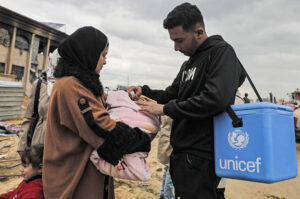
In Jabalia, north of the Gaza Strip, children received polio vaccines as part of the vaccination campaign conducted by UNICEF and its partners in 2025. Credit: UNICEF/Mohammed Nateel
By Shuli Wong
UNITED NATIONS, Jul 27 2026 – On Monday July 20, a team from the United Nations Office for the Coordination of Humanitarian Affairs (OCHA) visited two displacement sites in Gaza where they found two family tents decimated by domestic fires. This incident is indicative of the increasing frequency of domestic fires in Gaza.
Families are resorting to burning waste, cardboard, and trash to help prepare meals following the ban on gas cylinders and cooking stoves from entering Gaza since October 2023. While cooking gas is available, it is only offered in limited quantities and at extremely high prices.
The domestic fire risk in Gaza is situated within a larger, much more dire humanitarian access crisis, as documented in UNICEF’s Humanitarian Situation Update Mid-Year Review. Access restrictions and operational constraints continue to disrupt humanitarian delivery, with only 44 percent of aid trucks from Egypt able to offload between May and June. Severe restrictions remain in place for the entry of fuel, spare parts, and essential materials, which have driven system failures across health and water services. Across the Gaza Strip, an estimated 82 percent of families are water insecure, and nearly 90 percent of water and sanitation infrastructure has been damaged or destroyed.
Violence against civilians has also intensified across Gaza. The UN Human Rights Office reported that Israeli forces killed at least 57 people, including women and children, between July 13th and July 20th.
UN Spokesperson to the Secretary-General Stéphane Dujarric also detailed the aftermath of an Israeli drone strike on July 17th west of the Nuseirat refugee camp, in which seven people were reportedly killed and others injured as the strike coincided with mourners leaving a nearby funeral prayer.
On July 15th, a teacher was injured after being shot by Israeli forces while she was working at a temporary learning space west of Khan Younis. Since the start of 2026, OCHA has reported 26 education-related incidents. These findings echo their Humanitarian Situation Report from July 16th, in which 84 schools are under pending demolition or stop-work orders.
Despite operational constraints and security risks, humanitarian organizations have been working to restore and expand access to education after more than two years of disruption. At the beginning of 2026, UN partners helped 435,000 pre-primary and school-aged children, including 9,300 children with disabilities, access structured learning at 610 temporary learning spaces. Furthermore, 344,000 children received learning materials and 11,000 teachers were supported. UNICEF’s Mid-Year Review reported helping 266,000 children access formal and non-formal education opportunities, which has helped provide children with a sense of normalcy amid the ongoing upheaval and crisis.
Since the ceasefire was reached last October, there have been some improvements and gains in food security and nutrition levels, thanks to expanded humanitarian food, nutrition and agricultural assistance. But those gains are still fragile. UNICEF, the Food and Agricultural Organization (FAO) and the World Food Programme warned that families are struggling to meet basic needs, and these gains will be reversed without continuous humanitarian aid, funding and investment in recovery in the Gaza Strip. As of now, only one crossing, the Kerem Shalom/Abu Salem crossing in the south of Gaza, remains open for humanitarian assistance. The latest analysis on food security shows that an estimated 1.4 million people, or 67 percent of Gaza’s population, are experiencing crisis or worse levels of food insecurity.
Health and infrastructure remain heavily strained across the Gaza Strip. On July 20th, the Deputy Humanitarian Coordinator Susanne Tkalec met with leadership members of the Emirati Hospital in Rafah to determine solutions to strengthen the medical waste management systems in Gaza amid ongoing health and sanitation system stress.
Despite hospitals being explicitly protected under international humanitarian law, “healthcare workers, patients, ambulances, and hospitals have all been targeted,” said Dr. Javid Abdelmoneim, International President of Médecins Sans Frontières. Dr. Abdelmoneim went on to explain that “whether through direct violence, dismantling the healthcare system or obstructuring humanitarian assistance, inducing famine, weaponising water, causing higher levels of prematurity and mortality among infants and high levels of miscarriage, or denying care… it’s clear: the number one health issue in Palestine is Israel’s occupation.”
Shelter needs across Gaza remain outmatched by supply. In the first ten days of July, UN humanitarian partners provided 2,300 households with bedding items, tarpaulins and tents, and 13,000 families received kitchen sets. However, access to cooking fuel is still severely limited, as noted by the domestic fires. In addition, the supply stockpiles themselves are severely limited, with less than 1,000 tents currently available and only enough essential household supplies to support 7,000 families.
Across the occupied Palestinian territory, UN agencies continue to warn that violence, funding gaps, and access restrictions have created an unprecedented need that continues to outpace what can be delivered in terms of water, healthcare, education, and shelter.
IPS UN Bureau Report
!function(d,s,id){var js,fjs=d.getElementsByTagName(s)[0],p=/^http:/.test(d.location)?’http’:’https’;if(!d.getElementById(id)){js=d.createElement(s);js.id=id;js.src=p+’://platform.twitter.com/widgets.js’;fjs.parentNode.insertBefore(js,fjs);}}(document, ‘script’, ‘twitter-wjs’);


 Bahraini Dinar Exchange Rate