
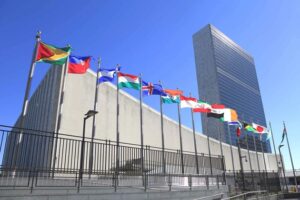
Credit: United Nations
By Amitabh Behar
DELHI, India, Jul 29 2026 – On 15 September 1953, Vijaya Lakshmi Pandit of India was elected the eighth president of the UN General Assembly — the first woman to hold the UN’s second-highest position. Since then, only four women have followed her, most recently the current president, Annalena Baerbock. Since its founding, the UN has had nine Secretaries-General. All men. Now, 81 years after the UN’s founding, we have a historic opportunity to correct that record. It is time to entrust the UN leadership to a woman of the Global South who shapes a more inclusive, effective and forward-looking UN.
The stakes extend far beyond symbolism. In the coming weeks, attention will turn to the Security Council, where the informal straw polls will effectively determine who emerges as the next Secretary-General, before it forwards its recommendations to the General Assembly for appointment.
Of the six candidates currently in the race, four are women, Michelle Bachelet, Rebeca Grynspan, María Fernanda Espinosa and Carolyn Rodrigues-Birkett. Their credentials leave no doubt that the UN has highly qualified women ready to lead. The choice facing UN member states, and especially the Permanent Five is therefore not whether a woman can lead the organisation, but which candidate is best placed to pull multilateralism back from the brink, revers trends of conflict and inequality, uphold international law, and restoring confidence in cooperation as a force for justice and human dignity.
That is no small task. The next Secretary-General will need to provide principled leadership to advance the interests of people whose voices are excluded from global decision-making, while defending the UN’s independence from its most powerful members. Trygve Lie, the first Secretary-General, once called the job “the most impossible job in the world.” This quote has rarely been proven righter than today.
The organisation the next Secretary-General inherits is not in good shape. A recent poll found that just 4% of people in the Global South believe the UN has sufficient authority in global governance; 44% blamed the concentration of power among the Permanent Five in the Security Council. Yet the same poll affirmed the need of the UN in this context with its enduring value as the only universal forum where all member states can address shared challenges — and the need for a Secretary-General who listens to people.
That points to four non-negotiable commitments that should anchor the next Secretary-General’s agenda: representation, participation, accountability and the right to self-determination. Among these four commitments accountability matters most urgently to stop impunity. Committing to it means real reform of a Security Council where the Permanent Five too often act as judge and jury: prioritising prevention, curbing the veto, strengthen the equality of all Security Council members in decision-making so advancements to global peace cannot be blocked, limiting the “penholder” system that lets the P5 monopolise drafting, and putting civilian protection at the centre of every peacekeeping effort.
Ultimately, addressing these structural challenges will require a broader conversation about the future of the UN Charter itself, including serious consideration of Article 109 as a pathway for reviewing whether the Organization’s founding framework remains fit for purpose in today’s world.
Translating these commitments into people’s lives means concrete action in a few key areas: Inequality must finally move to the centre of the UN agenda: billionaire wealth has hit a historic $18.3 trillion and only 16% of the Sustainable Development Goals remain on track. Establishing an International Panel on Inequality, modelled on the Intergovernmental Panel on Climate Change, will be a vital next step in tackling the inequality emergency.
Civilian protection and defending international humanitarian law must be non-negotiable to dismantle systems of impunity, at a moment when dozens of people fall into humanitarian emergency every minute. And with the world badly off track on the Paris Agreement, the next Secretary-General must build on Antonio Guterres’ legacy and continue pushing to make a just transition away from fossil fuels — backed by real climate finance — a defining political priority.
The next Secretary-General must put a feminist vision at the heart of the UN. This means confronting a rigged, sexist, and racist economic order that prizes endless growth over the care of people and the planet, and backing the Roadmap for Eradicating Poverty Beyond Growth. And none of this will happen if civil society is sidelined and fundamental rights -including digital ones – are not protected while Artificial Intelligence keeps expanding without control. The UN’s legitimacy depends on hearing from the people it was built to serve — the Charter’s founding principle of “We the Peoples” — especially as civic space shrinks worldwide including in the UN.
In her inaugural address as UNGA president, Pandit said the world “must learn to cooperate effectively in safeguarding peace and in raising standards of living.” Seventy-three years on, as multilateralism strains under the weight of its own contradictions, that sentence has lost none of its urgency.
Leading the UN of tomorrow might be the hardest job in the world. But as Lie also said, the harder the task, the greater the reward. It is time for structural change — and for a woman of the Global South to lead it. We cannot afford to miss this opportunity. The coming weeks, and the opening of the 81st session of the General Assembly, will show whether world leaders are ready to seize it
Amitabh Behar is Oxfam International’s Executive Director
IPS UN Bureau
!function(d,s,id){var js,fjs=d.getElementsByTagName(s)[0],p=/^http:/.test(d.location)?’http’:’https’;if(!d.getElementById(id)){js=d.createElement(s);js.id=id;js.src=p+’://platform.twitter.com/widgets.js’;fjs.parentNode.insertBefore(js,fjs);}}(document, ‘script’, ‘twitter-wjs’);


 Bahraini Dinar Exchange Rate